Year: 2022

  • Players continue to help the community

    Originally published: January 6, 2022
    https://www.steelers.com/news/players-continue-to-help-the-community


    The Steelers announced another donation to their Social Justice Fund for 2021, with players making donations and the team providing a matching commitment to help support community efforts.

    The Urban League of Greater Pittsburgh will receive $6,000 after donations from offensive linemen Trai Turner and Kevin Dotson, and a matching contribution from the team.

    The mission of the Urban League of Greater Pittsburgh is to enable African Americans to secure economic self-reliance, parity and power, and civil rights.

    “We are appreciative of the Steelers organization and the players that make up the Social Justice Fund and applaud their efforts to uplift organizations in the community like the Urban League that are seeking to empower individuals to achieve greatness,” said Carlos T. Carter, Urban League of Greater Pittsburgh President & CEO. “We are especially appreciative of their recent gift from the fund that will support our Black Female and Black Male Leadership Development Institutes. The purpose of these individual programs has never been more important. They exist to empower our young people to lead a life of excellence, to pursue greatness, to become advocates for themselves and to use and seek out the resources available to them. We continue to be inspired by the support of the community not only of our Leadership Development Institutes but for the entire agency.”

    Since 2018, Steelers players contributions, along with the matching donations from Steelers Charities, have benefitted more than 57 charitable organizations throughout the region.

    Steelers President Art Rooney II said, “I am proud that we can join with our Steelers’ players in making these contributions through our Social Justice Fund that contribute to so many charitable efforts in our community.”

  • Interview: Sunday Business Page: Urban League of Greater Pittsburgh

    KDKA’s Jon Delano spoke with the new President of the Urban League of Greater Pittsburgh, Carlos Carter, about his goals for the organization.

    Sunday Business Page: Urban League of Greater Pittsburgh – News, Sports, Weather, Traffic and the Best of Pittsburgh (cbslocal.com)

  • Take Charge Of Your Health Today. Be Informed. Be Involved….Healthy aging

    Originally Published: February 16, 2022
    Take Charge Of Your Health Today. Be Informed. Be Involved. | New Pittsburgh Courier

    Why is promoting healthy aging so important for our Black/African American elders?  

    Promoting healthy aging is important because we want Black people to age gracefully and live their best lives in retirement.  The reality is when you are not healthy your quality of life is compromised, and your lifespan is at risk of being shortened.  Unfortunately, Blacks and other marginalized communities face more health issues resulting from lack of exercise and lack of access to healthy foods. As a result, obesity is a major issue for many Americans, but it is worse for Black Americans due to poor diet choices and high caloric intake. This underscores the importance for better access to good foods and for people to make better diet choices when there are options.

    Community health workers help to build trust and make achieving these changes in our lifestyle doable. What ideas do we have for increasing this kind of intervention in our Black/African American communities?  

    Education and access are critical. We need to increase engagement with Black communities through increased partnerships with barbershops, hair salons, churches, senior programs, individual families, and anywhere that Black people live, work and play. We need to stress the importance of healthy eating and the importance of staying mobile through walking and other exercise. I recommend that we find innovative and ongoing ways to better educate people about exactly what is healthy eating as people have different interpretations of what healthy eating is.

    How can we further disseminate this information about how to achieve healthy aging?    

    We should leverage media like television, internet and others. It’s critical to start educating younger children who will one day become the older generation. This will position Black people and other marginalized communities to have the information necessary to make better choices. It is also important for Blacks to have access to healthy foods in their communities. This will further empower them to be able to make good choices in their day-to-day lives.

  • ‘A beacon of hope’: Pittsburgh’s Black leaders celebrate Supreme Court confirmation of Ketanji Brown Jackson

    The confirmation of Ketanji Brown Jackson to the Supreme Court — making her the first African American woman to serve on the nation’s highest court — was a historic moment, Allegheny County President Judge Kim Berkeley Clark said.

    Judge Clark would know about historic moments: She is the first African American to serve as president judge of the Allegheny County Court of Common Pleas.

    But to Judge Clark, and many others in Pittsburgh’s Black community, the confirmation of Judge Jackson on Thursday meant more than history. It symbolized that African Americans — especially girls and women — can accomplish great things, they said.

    “Judge Jackson is a brilliant jurist who is highly qualified for this position,” Judge Clark said Thursday. “This is an historic moment for our nation. Judge Jackson will be a living example and inspiration for African American girls and women of what they can achieve.”

    While many of the city’s Black political and community leaders pointed out the significance of having a Black woman on the Supreme Court, they also noted Judge Jackson’s qualifications and the grace she displayed under the pressure of aggressive questioning during her confirmation hearings before the U.S. Senate.

    State Rep Summer Lee, D-Swissvale, said in a statement that she once again celebrated “the power of overqualified Black women in this country to overcome every obstacle thrown our way.

    “Judge Ketanji Brown Jackson’s confirmation is a long overdue moment for the Supreme Court to gain the diversity of viewpoints and background that it has glaringly lacked historically,” Ms. Lee said. “Black women deserve to not only have someone that looks like us on the Supreme Court, but someone who approaches the law and our justice system from the deeply rooted adversity that every single one of us are all too familiar with.”

    Ms. Lee, though, noted the hostility Judge Jackson faced during her confirmation hearing, saying that “it was shameful to watch Republican senators dog whistle and harass Judge Jackson throughout this confirmation hearing, and they do not deserve to hold the seats they occupy.”

    Esther Bush, who retired last year after nearly three decades at the helm of the Urban League of Greater Pittsburgh, said she did not know much about Judge Jackson before President Joe Biden nominated her for the Supreme Court.

    However, Ms. Bush said she was not surprised by Judge Jackson’s ability to keep her composure while facing antagonistic questioning from some Republican senators.

    “When a Black woman gets to where she is right now sitting in that seat, I already know that everything that she says and does is tight and appropriate,” Ms. Bush said. “And I’m not putting her above anybody. I am saying I’m positive she has already fought a good fight, and she was not going to do anything different at this peak in her career and for America.”

    Ms. Bush said she got “chill bumps” thinking about how Vice President Kamala Harris, the first Black woman to serve as vice president, presided over the confirmation of Judge Jackson.

    We should have reached this moment a long time ago, Ms. Bush said. But, she concluded, we are here now.

    She said it is important for Americans to embrace the change that the country is going through instead of trying to hold back progress.

    “The reality is there, they can’t change it,” Ms. Bush said. “All this gerrymandering and stuff, they don’t even care if they get caught. And all these things do tie into her appointment. It’s all a part of where America is, and where America is going.”

    The new CEO of the Urban League, Carlos T. Carter, said it was time to have the voice of a Black woman on the Supreme Court.

    “It’s just a sign of some progress we’re having,” he said. “We have a long way to go as a country, but she’s a bright spot for sure, and a beacon of hope for all Black girls and Black people and all people to know that there is light.”

    Mayor Ed Gainey congratulated Judge Jackson for “shattering the proverbial glass ceiling.”

    “Her confirmation represents a milestone opportunity for our democracy to acknowledge the leadership Black women have always exhibited,” Mr. Gainey said in a statement.

    Judge Jackson’s confirmation speaks to what’s best in America, said City Councilman Ricky Burgess, who also noted the importance of having a Black woman on the Supreme Court.

    “On this historic and significant day, I am almost moved to tears,” Mr. Burgess said. “This elevation of Judge Jackson is a tangible and concrete symbol that African American women have status and significance in this country.”

    When asked about his reaction upon hearing that Judge Jackson had been confirmed Thursday, Mr. Burgess simply said “Finally.”

    State Rep. Austin Davis, D-McKeesport, said the first person he voted for after turning 18 in 2008 was Barack Obama.

    Mr. Obama’s election as president, Mr. Davis said, was the first time that he realized he could run for office. He said that the confirmation of Judge Jackson to the Supreme Court may provide a similar revelation to young Black girls.

    “If you’ve never seen a school teacher or a lawyer that looks like you, it’s hard to believe that you can do it, that you would be the person to [do] it,” Mr. Davis said. “Representation really does matter.”

    Andrew Goldstein: agoldstein@post-gazette.com.

    First Published April 7, 2022, 7:55pm
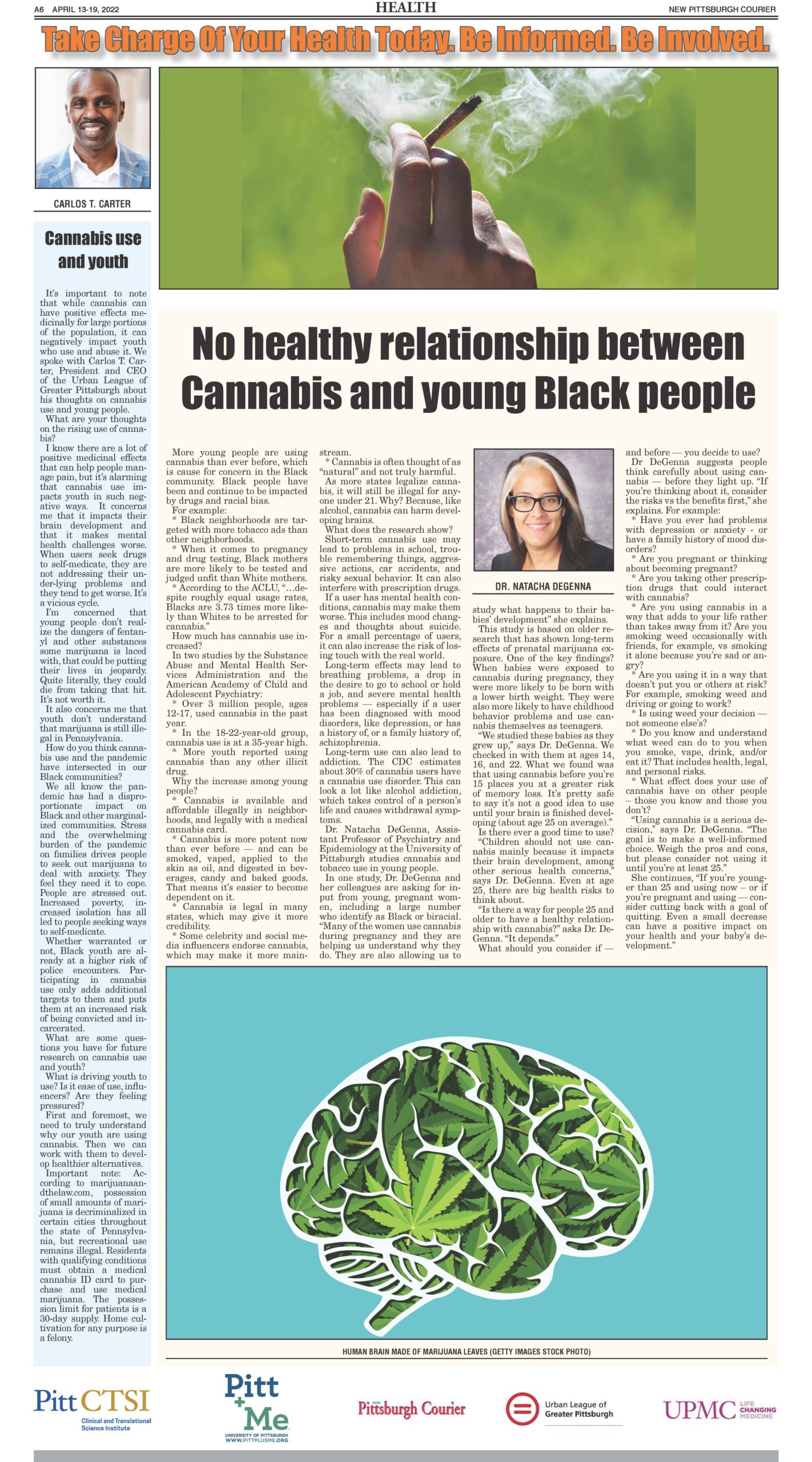
     

  • Take Charge of Your Health. Be Informed Be Involved… Cannabis Use and Youth

    Published 4/13/2022
    New Pittsburgh Courier

    It’s important to note that while cannabis can have positive effects medicinally for large portions of the population, it can negatively impact youth who use and abuse it. We spoke with Carlos T. Carter, President and CEO of the Urban League of Greater Pittsburgh about his thoughts on cannabis use and young people.

    What are your thoughts on the rising use of cannabis?  

    I know there are a lot of positive medicinal effects that can help people manage pain, but it’s alarming that cannabis use impacts youth in such negative ways.  It concerns me that it impacts their brain development and that it makes mental health challenges worse. When users seek drugs to self-medicate, they are not addressing their under-lying problems and they tend to get worse. It’s a vicious cycle.

    I’m concerned that young people don’t realize the dangers of fentanyl and other substances some marijuana is laced with, that could be putting their lives in jeopardy. Quite literally, they could die from taking that hit. It’s not worth it.

    It also concerns me that youth don’t understand that marijuana is still illegal in Pennsylvania.

    How do you think cannabis use and the pandemic have intersected in our Black communities? 

    We all know the pandemic has had a disproportionate impact on Black and other marginalized communities. Stress and the overwhelming burden of the pandemic on families drives people to seek out marijuana to deal with anxiety. They feel they need it to cope. People are stressed out. Increased poverty, increased isolation has all led to people seeking ways to self-medicate.

    Whether warranted or not, Black youth are already at a higher risk of police encounters. Participating in cannabis use only adds additional targets to them and puts them at an increased risk of being convicted and incarcerated.

    What are some questions you have for future research on cannabis use and youth?

    What is driving youth to use? Is it ease of use, influencers? Are they feeling pressured?

    First and foremost, we need to truly understand why our youth are using cannabis. Then we can work with them to develop healthier alternatives.

    Important note: According to marijuanaandthelaw.com, possession of small amounts of marijuana is decriminalized in certain cities throughout the state of Pennsylvania, but recreational use remains illegal. Residents with qualifying conditions must obtain a medical cannabis ID card to purchase and use medical marijuana. The possession limit for patients is a 30-day supply. Home cultivation for any purpose is a felony.

  • Highmark Health charts new course for social services reimbursement

    Highmark Health and Allegheny Health Network have begun a pilot program that seeks to bring a similar reimbursement system to what it uses for health care providers to nonprofits that provide social services.

    Recently, health insurers and hospitals have spent a significant amount of time on what are called the social determinants of health, which are factors like housing, food and transportation that impact health and welfare beyond illness and other medical issues. The impact of nonmedical issues on an individual’s health can be vast: Studies show about 80% of health is made up of these social determinants.
    Pittsburgh-based Highmark Health is working with 20 nonprofits in Allegheny and Westmoreland counties to pay them for providing services to members and patients who are referred to them for social services, food, job counseling and transportation. It plans to add 20 more nonprofits next year, said Nebeyou Abebe, Highmark Health’s SVP of social determinants of health.


    “There’s a recognition across the country that we need to focus on the root causes of poor health, and that is what is driving the work,” said Abebe. Highmark Health has been reaching so-called value-based reimbursement arrangements with doctors, hospitals and, increasingly, pharmaceutical companies in recent years as a way to rein in costs and improve health for patients. The idea is that reimbursement is tied to the patient’s overall health outcome or whether the medication met benchmarks.


    The pilot program extends that to social services, which are often referred at the provider or hospital level when there’s a concern. It’s being stepped up even more at AHN and Highmark, where patients and members are being screened for social needs and risk under nine categories that include food insecurity, transportation and social isolation. The patients are then referred first to case managers or social workers at AHN, and then to the social service agencies.


    “But historically we have no idea whether that social need has been met,” Abebe said. “The community benefit organizations have now been incentivized to share whether or not they were able to address the need.”


    In the case of a referral to a food bank, for instance, then Highmark and AHN will be able to know whether hunger and food insecurity has been addressed. That information can go into the patient’s electronic health record.
    “As the result of social need being met, we have removed that barrier to allow the person to focus on their health and well being,” Abebe said. “That’s the kind of insight we need and which is critical to understanding the true impact of addressing the social determinants of health and the long-term health outcomes.” The plan is to use the learnings from the pilot program to scale it up to the other states and regions of Pennsylvania where Highmark Health operates.


    “We will also be able to create the much-needed link between those patients whose social needs are addressed and the health care delivery system so that their health outcomes are improved and the burden of the otherwise avoidable health care costs is reduced,” said Dr. Tony Farah, Highmark Health’s EVP and chief medical officer.


    The $1 million pilot is being funded by the Richard King Mellon Foundation, which in May 2021 gave Highmark Health a $5 million grant for the development of digital health solutions like its Living Health initiative that provides personalized and digitally-based care for whole health.


    “Through the Foundation’s Health & Well-Being program, we seek to ensure that everyone in Allegheny and Westmoreland counties, particularly the most vulnerable, have the opportunity to live a healthy life,” said R.K. Mellon Foundation Director Sam Reiman in a statement.


    Abebe said that each nonprofit involved has the opportunity to earn up to $50,000 from the program, depending on the number of referrals. They’ll be paid on a semi-annual basis. “The services CBOs (community benefit organizations) provide are free or low costs. There’s a direct benefit for members to seek out that service to address their social needs, and the CBOs have been doing this for years but they haven’t been properly reimbursed for the services they’re providing,” Abebe said. The pilot will last three years.


    Highmark Health members across its service lines will be eligible for the programs, and Abebe said that it’s a myth that it’s just Medicaid and Medicare members who will need the services. He said that within commercial insurance, there are employers who have a large number of employees who are either the working poor or who are struggling with transportation and housing issues. “Maybe the need is greater in the Medicaid space … but we recognize that our commercial customers are also struggling and that we need to provide the right level of support for them as well,” Abebe said. “Many of them aren’t able to address their health needs because of these social barriers.”


    The nonprofits involved in the first-year pilot program are: Action-Housing Inc.; Adagio Health Inc.; Allegheny Valley Association of Churches; Cornerstone Care Community Health Centers; Crisis Center North Inc.; Greater Pittsburgh Community Food Bank; Holy Family Institute; Jewish Family and Community Services; Just Harvest; Mon Valley Initiative; Pittsburgh Community Services Inc.; Pittsburgh Financial Empowerment Center; Rebuilding Together; Society of St. Vincent de Paul Central Council of Pittsburgh; South Hills Interfaith Movement; Traveler’s Aid Society of Pittsburgh; Urban League of Greater Pittsburgh Inc.; Wesley Family Services and Westmoreland Community Action.

  • Take Charge of Your Health. Be Informed. Be Empowered.

    Topic: Precision Medicine and Chronic Kidney Disease
    Originally Published: August 10,2022


  • People on the Move

    Originally Published: 8/29/2022
    Pittsburgh Post Gazette

    Nonprofit

    The Urban League of Greater Pittsburgh hired John Ukenye as its advocacy and policy officer; Joshua Smith, associate director of youth leadership programs and director, Black Male Leadership Development Institute; Ginger Underwood, program manager, Black Female Leadership Development Institute and Loretta Ellis, opportunity broker.