Month: April 2024

  • Urban League’s East Hills Family Support Center ‘reintroduced’ to its residents

    Urban League’s East Hills Family Support Center ‘reintroduced’ to its residents

    Originally posted on April 12, 2024 in the New Pittsburgh Courier

    Urban League’s East Hills Family Support Center ‘reintroduced’ to its residents

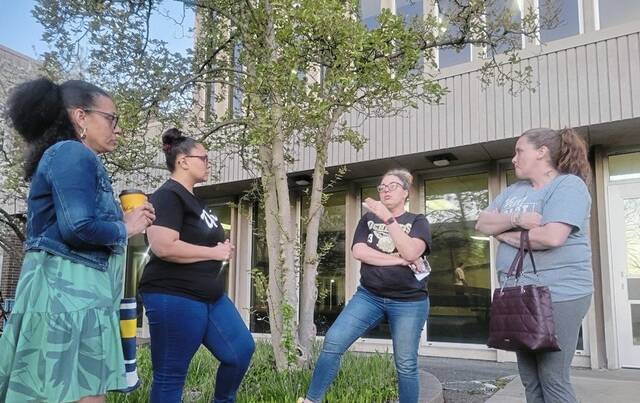
    Some of the staff of the Urban League’s Family Support Centers, which are located in East Hills, Duquesne and Northview Heights. A “Dress for Success” event was held, Feb. 28, at the East Hills location. (Photo by Rob Taylor Jr.)

    Programs and fun activities being planned as spring hits 

    On Feb. 28, the Urban League of Greater Pitts­burgh’s East Hills Fam­ily Support Center was packed with local resi­dents checking out the professional attire they may need for their next job interview.

    But that’s only part of what happens there.

    Similar to how universi­ties have a main location and then satellite branch­es, the Urban League works the same way in Pittsburgh. Its headquar­ters is Downtown at 332 Fifth Avenue inside the Warner Center, but it has three Family Support Centers—Duquesne, at 1 Library Place; Northview Heights, at 437 Mt. Pleas­ant Road; and East Hills, at 2320 East Hills Drive Rear.

    Maurice Lucas, the East Hills location’s site di­rector, partnered with the people at Dress For Success Pittsburgh, who brought a wide variety of casual and professional clothing that residents re­ceived—for free.

    People like Darlene Hunter, of Northview Heights, and Adele Whit­son, of East Hills, attend­ed and found some nice clothing, they told the New Pittsburgh Courier. For Whitson, she said af­ter 13 years of her job in food service, she’s looking to secure a job interview for a different type of job, but a job that still allows her to work with people.

    “We provide clothing to women who are entering or returning to the work­force, or are going through some sort of transition,” said Alex Marks, the Dress For Success Pittsburgh Mobile Services Lead. “We hope to provide them with clothing, connec­tions and confidence to get to that next step in their life.”

    The event also served as a way to introduce or reintroduce the locals to the East Hills Family Support Center. While the East Hills Commu­nity Center is just a stone’s throw away, the Family Support Center is the connection be­tween all that the Ur­ban League has to offer and the people of East Hills.

    “These centers are here to really help em­power the families,” Carlos Carter, presi­dent and CEO of the Urban League of Great­er Pittsburgh, told the Courier at the Feb. 28 event. “We have emer­gency food pantries in here, we help with jobs, we help remove barri­ers, in terms of if they need rental assistance, they can connect to the greater Urban League; if they need rides to doc­tor’s appointments, we take them…”

    The East Hills Fami­ly Support Center also assists people with free pampers.

    Lucas, the site director, told the Courier there’s more plans in the works to get the residents more connected to the center. He’s planning a grand reopening cele­bration tentatively in May, complete with out­door inflatables, games for the kids, free food on the grill, and more.

    Lucas also wants the Family Support Center to be known as a place where tutoring takes place, there’s movie nights for the kids, and overall, a true resource outlet for the East Hills community.

    “A lot of people don’t know how easy it is to find a resource,” Lucas told the Courier. “With us being that liasion, we can help get them to where they want to be instead of where they have to be.”

    (Editor’s note: For more information on the Urban League’s East Hills Family Support Center, call 412- 727-2640.)

  • As Pittsburgh’s homeless crisis continues to escalate, finding solutions has proven difficult

    Originally published on April 3, 2024 in Pittsburgh Post-Gazette

    As the city grapples with a growing homeless population, some local service providers and Pittsburgh city officials have different ideas on solutions, and those conflicting priorities threaten to prolong an already escalating crisis.

    City and county officials have advocated for ideas such as building tiny houses as they continue to clear homeless encampments throughout Downtown. At the Pittsburgh-based Salvation Army, shelter stays have ballooned in recent years — now averaging over five months long.

    Clients must take what housing options are available and, for the vast majority of them, that’s subsidized housing or a rental on the private market.

    But Sherry Rorison, the organization’s director, considers transitional housing the optimal choice for people experiencing homelessness, as that option offers supportive services for up to 24 months, including help with mental health and addiction.

    “You’re working towards goals, and you don’t have to worry about taking care of yourself because you have a roof over your head,” Ms. Rorison said. “If you want to go back to school, you can. You’re working with a case manager to attain those goals. It just makes more sense to me.”

    City efforts to develop this type of housing have stalled.

    Homelessness in the city reached a 12-year high in 2022, and Pittsburgh City Council repeatedly considered a variety of tangible, affordable housing solutions, many of which focused on increasing transitional housing. But few of those plans have come to fruition.

    A subcommittee of council members presented three options — one of which was a village of tiny homes, which made its way to legislation, but is currently languishing in the city’s Planning Commission.

    The tiny homes village, spearheaded by council members Deb Gross and Anthony Coghill, was an effort to create more cost-effective transitional housing. Plans for the village also included electricity, food, shared restroom facilities and round-the-clock wraparound services, including mental health and housing assistance.

    Mayor Ed Gainey’s office and members of the Planning Commission pushed back on the idea, saying there were at least two problems with the way the legislation was written: that the proposal didn’t match up with the city’s zoning codes and that it would make current tent encampments illegal. The legislation is now on an eight-week hold while the bill’s language is reviewed; it is expected to be up for a vote in mid-April.

    Even if it’s approved, it has to go back to council for final passage, extending the already monthslong process.

    Downtown Pittsburgh homeless encampment closes as officials work on more stable solutions

    The council subcommittee also offered options — and detailed plans — to build new transitional housing from the ground up as well as to use already existing, city-owned buildings for additional housing. Neither has advanced.

    In the same time period, Mr. Gainey channeled his efforts toward increasing the city’s stock of affordable housing.

    He signed into law an expansion of the affordable housing overlay zone from Lawrenceville into Bloomfield and Polish Hill. That zoning ordinance requires 10% of new construction or renovation projects that produce over 20 housing units to remain affordable for qualified, low-income individuals — whether they are for rent or for sale.

    In July 2022, the mayor reallocated about $2 million of federal funding to kick-start the Downtown Conversion Project to convert Downtown office space into affordable housing units.

    The focus on permanent affordable housing is part of an emerging “Housing First” homeless assistance approach that’s growing across the country. It prioritizes providing permanent housing to improve unhoused people’s quality of life.

    “You can work with the client longer, teach them life skills they were never taught,” Ms. Rorison said. “You get all the programming that you need to succeed.”

    Without providing the “quality care” that people experiencing homelessness need and offering only a rental unit, the cycle can perpetuate, she said. She believes that’s unfair to the person in need and to the status of overwhelmed shelters.

    “It just creates a backlog,” Ms. Rorison said.

    Council members have also requested that various departments work together to produce three reports: one to outline city-owned parcels of land that could be used for emergency shelters, tiny homes or the construction of more affordable housing; one for details surrounding “accessory dwelling units” — sometimes called “granny flats” — in which separate living space exists inside a primary residence or on the same property; and one for details surrounding “limited-equity cooperatives,” which are larger apartment buildings owned by the residents, with buy-in at a below-market rate.

    Councilwoman Theresa Kail-Smith said last week that if the reports ever materialized, she was “not aware of it.”

    The conflicting priorities in city government came to a head in March when the Gainey administration brought council a spending plan for an $8 million federal grant, about $6 million of which would go to the Urban Redevelopment Authority to create affordable rental units, specifically for people experiencing or at risk of homelessness.

    Council members acknowledged that more affordable housing was something the city needed, but they wished the money was going toward things that would help people more immediately.

    Officials from the URA estimated that the rental units wouldn’t be completed for at least 18 to 24 months.

    “We could have already been housing people if we both had moved more quickly on allocating these funds,” Ms. Gross said, noting that even with Gainey’s $6 million allocation, it could “still take several years before a single person gets housed.”

    “That was the tragedy that could have been avoided,” she said.

    Council members also said they were frustrated by the lack of communication about the spending plan. Many said they were not given a chance to give their input regarding where the money should be spent.

    “My concern here is that we basically have two separate tracks of conversation about what to do for the homelessness in our city,” Ms. Gross said during council discussion of the spending plan. “There shouldn’t be two separate tracks.”

    As government officials battle over what plan to proceed with, some service providers are also feeling left out of the conversation.

    Despite working directly with the people who experience this reality every day, Ms. Rorison noticed a disconnect between providers and city leaders.

    She first learned of the city’s debate over the federal grant from one of her own clients, an unhoused person who regularly attends City Council meetings. Ms. Rorison, disappointed to have learned about millions of dollars in resources this way, said communication between council and providers like herself can be practically nonexistent.

    “For me, just to go each time and wait for them to talk about homelessness, it’s hard,” she said. “You would think they’d want to invite us. I would have loved to have been part of the discussion on how we can best use that money. I think any provider would feel that way.”

    Mr. Coghill recently called for a public meeting with the mayor, the county and service providers so that everyone could work out a cohesive plan together.

    Getting all of the interested parties together is one of the hurdles to solving this problem, Ms. Kail-Smith said.

    “It’s a challenge to find a solution,” she said. “I think that part of the problem is this is not a simple project, and there’s a lot of people with a lot of interest in what happens and where it happens.”

    But the consensus is that something needs to be done.

    Carlos T. Carter, the president and CEO for the Urban League of Greater Pittsburgh said a large-scale plan should be developed to address housing, both in its quality and affordability.

    “We need to see this less as an individual’s problem, and more so a societal and policy failure,” Mr. Carter said. “As a community, we need to take responsibility for each member’s safety and quality of life, so that we can thrive together.”

    He would like to see further examination of funding for securing and renovating blighted and abandoned properties outside the Pittsburgh city limits and thinks the initiatives around converting corporate spaces into housing should be “highly considered.”

    While Mr. Carter would be interested in learning more about some of the solutions council has previously proposed, particularly the mutual-housing developments, the Urban League does not advocate for short- and intermediate-term solutions that do not put individuals “on the path of self-sufficiency and eventual homeownership,” he said.

    “All individuals are entitled to a life of dignity and privacy, and this is no less true for our houseless neighbors,” Mr. Carter said.

    Hallie Lauer: hlauer@post-gazette.com; Jordan Anderson: janderson@post-gazette.com

    First Published April 2, 2024, 5:30am

  • PRESS RELEASE: Urban League of Greater Pittsburgh and Education Law Center Call for Action to Address Racial and Disability Discrimination in Highlands School District

    Photo by Tawnya Panizzi, Valley News Dispatch/Tribune Review


    Articles on this topic:

    • WESA: Click here.
    • Tribune Review: Click here
    • Post-Gazette: Click here.

    [Pittsburgh, PA – April 11, 2024] – The Urban League of Greater Pittsburgh (Urban League) and the Education Law Center-PA (ELC) have jointly sent a letter to the Highlands School District — following community concerns and discussions with alumni, parents, and students — identifying several pressing issues affecting students of color and students with disabilities within the Highlands School District. These issues include instances of reported racial discrimination and harassment, disproportionate disciplinary actions against students of color, and failure to provide adequate support to students with disabilities as outlined in their Individualized Education Plans (IEPs) and 504 Plans.

    The Urban League and ELC have proposed an action plan aimed at fostering positive change and ensuring a supportive environment for all students within the Highlands School District.

    Key components of the proposed action plan include the appointment of an independent monitor to oversee implementation of the action plan, revision of policies and practices on reporting and addressing racial harassment, discipline, special education, and dress code, as well as stakeholder engagement and comprehensive training for school staff.

    “As a parent, I was disheartened to see firsthand the trauma, shame, and defeat suffered by students in a school district that is charged with the duty to educate, protect, empower, and prepare our students for a bright future. A key focus of the Urban League, both nationally and locally, is our ‘Three Ds,’ one of which is to Demand Diversity, Equity, And Inclusion everywhere, including the classroom. We are hopeful that, by working collaboratively with the Highlands School District, we can implement meaningful reforms that address systemic inequalities and promote equity for all students. We are deeply committed to fostering an environment where all students feel safe, supported, and valued,” said Urban League of Greater Pittsburgh President & CEO, Carlos T. Carter.

    “Highlands School District has the legal responsibility to ensure that its schools are free from racial and disability discrimination,” said Hetal Dhagat, Senior Attorney with Education Law Center-PA. “The proposed action plan represents a significant step towards addressing longstanding issues of inequity within the Highlands School District and creating a more inclusive and supportive learning environment where all students can thrive. We stand ready to collaborate with the District and Highlands community to achieve these goals.”

    The Urban League and the Education Law Center urge Highlands School District to commit to implementing the proposed action plan. Together, with the support of the community and district stakeholders, the plan aims to help bring about positive change and ensure the well-being and success of all students within the Highlands School District.

    For media inquiries, please contact Jarrod Williams at chiefadmin@ulpgh.org/412-227-4150 and Hetal Dhagat at hdhagat@elc-pa.org/412-258-2117.

    Ranked as one of the nation’s highest-performing affiliates for more than a decade by the National Urban League, the Urban League of Greater Pittsburgh was founded in 1918 with the shared National Urban League mission of enabling African Americans to secure economic self-reliance, parity, and power and civil rights.


    The Urban League of Greater Pittsburgh focuses on serving African Americans and other marginalized communities, but no one is ever turned away, helping more than 20,000 individuals in Pittsburgh and the surrounding counties last year alone. As the largest comprehensive social service/civil rights organization in Southwestern Pennsylvania, the Pittsburgh Urban League helps others to help themselves through extra-curricular educational opportunities, health advocacy, housing counseling, parental education and support for early childhood and youth development, hunger prevention services, sustainable wage career preparation, and other programs that lead to improved ability to achieve economic empowerment and self-reliance. For more information, visit ulpgh.org or @ulpgh on Facebook and Instagram.


    The Education Law Center is a non-profit, legal advocacy organization with offices in Pittsburgh and Philadelphia dedicated to ensuring that all children in Pennsylvania have access to a quality public education. Through legal representation, impact litigation, community engagement, and policy advocacy, ELC advances the rights of underserved children, including children living in poverty, children of color, children in the foster care and juvenile justice systems, children with disabilities, multilingual learners, LGBTQ+ students, and children experiencing homelessness. For more information, visit elc-pa.org or @edlawcenterpa on Twitter.


  • Snowstorm? No match for annual Ronald H. Brown Leadership Awards Gala

    Urban League’s annual event sees more than 400 attend, $400,000 raised

    Neither frigid temperatures nor a winter storm advisory kept the more than 400 celebrants from attending the Urban League of Greater Pittsburgh’s 28th annual Ronald H. Brown Leadership Awards Gala on Friday, Feb. 16. The guests gathered at the Rivers Casino ballroom on the North Shore for a virtual “Who’s Who in Black Pittsburgh.” Just some of the power brokers present were Pittsburgh’s Mayor, Ed Gainey; Dr. Kathy Humphrey, President of Carlow University, William Generett Jr., Esq., Vice President of Civic Engagement and External Relations at Duquesne University, and Demeatria Boccella, President of Fashion Africana. Additionally, two CEOs from other Urban League branches were in attendance; Darrin W. Anderson Sr., Ph.D., M.S., President and CEO, Urban League of Philadelphia, and Dr. Erin R. Houston, Ph.D., President and CEO, the Shenango County Urban League Inc.

    This year’s honorees were: Carmen Anderson (Vice President of Equity and Learning, The Heinz Endowments), Civic Leadership Award; Derrick Tillman (President, Bridging the Gap Development), Civic Leadership Award; Leah Lizarondo (CEO and co-founder of 412 Food Rescue), Community Leadership Award; and Alexandra Jones, Emerging Leadership Award.

    Pennsylvania’s Second Lady, Blayre Holmes Davis, and Bryan Iams presented a joint welcome, after which, there was a video message from the Governor of Pennsylvania, Josh Shapiro, extending his personal congratulations to both the Urban League of Greater Pittsburgh and the honorees.

    Andrew Stockey, of WTAE-TV (4), served as the emcee and facilitated receiving the honorees to the podium.

    Anderson, who specifically oversees The Heinz Endowments’ funding that serves women and children, spoke of what civic leadership means to her, and the importance of providing the means that pour into the children.

    “Our dreams cannot become reality for more than a few until we collectively have the will and determination to use our power to challenge injustice and oppression, to challenge hate in all its forms, and to stand in the gap for our children,” Anderson said after receiving her award. “They deserve a world where they can live to their potential. Civic leadership, to me, is more than just about leading; it’s about listening, learning and creating meaningful change. It’s about planting seeds for the future…This award serves as a reminder that leadership is not a position or title, but an example and action, and challenges us to always seek out ways to serve others before ourselves.”

    Tillman said he first gave all honor to God “for giving me intellectual ability, work ethic and strength. I am reminded that I cannot be here on my own—the Word says your gifts will make room for you and bring you before great men, and as I look around this room, I see nothing but great men and women.”

    Tillman, who, among other projects, is behind the Fifth & Dinwiddie development in Uptown, thanked his mother, his mentor, Greg Spencer, and his wife, Nykia. “My wife never stopped keeping me encouraged, pushing me, and being my number 1 fan,” he said.

    Tillman continued: “Rosa Parks once said each of us possesses the power to become agents of change. Now I believe this for myself. I grew up in poverty, I experienced firsthand just how traumatic this can be and how poverty impacts every area of our lives and every decision of our lives. Bridging the Gap Development works to bridge gaps of opportunity, and bridge gaps in development for this region and beyond. Behind the scenes I give my time by sitting on boards, commissions and councils working to level the playing field to open up significant doors of opportunities for other minority enterprises and Black developers across the commonwealth. Our focus has been to impact the economic agenda for our people in this region and beyond. Martin Luther King Jr. once said, ‘What good is it to be able to go into a restaurant when you can’t afford the menu?’ I’ll add to that by saying, what good is it to get the degree, purchase a home, or start the business, if you are constantly struggling to keep it. If you are not thriving, then we face the question of what your quality of life is. We must remember, Superman is not coming; God sent us! We are the ones we have been waiting for.”

    Lizarondo shared her thanks for the award and stated that 412 Rescue “is about everyone in this room, that is the real magic of it. There are many faces in here who have been part of this bold, grassroots movement that Pittsburgh has introduced to the world. 412 Food Rescue’s homegrown technology is now being used all over the United States—they all want the movement we have created here. This truly exemplifies to me the true meaning of community. This is a technology, and I’m grateful to the foundations who listened to me when I said I had an app. I am grateful to the nonprofits in the room who, when asked if we’d bring food, would they give it to the people they serve, and there are 20,000 Pittsburghers who have downloaded the app and are getting notices every day.

    The 412 Food Rescue app gives its volunteers the ability to get food that otherwise would have gone to waste into the hands of those who need it.

    As for Jones, the recipient of the Emerging Leaders Award implemented by new Urban League of Greater Pittsburgh President and CEO Carlos Carter, said she’s the type of person to get her hands dirty and “do the work necessary to get the job done. When I am asked to help, and I know I am able to, and it is for the greater good, I’ll figure it out—from community service chair of the Urban League Young Professionals, to volunteering at the diaper bank and ending up their first employee—I say yes. Starting Aliquippa Green was about educating and empowering the community by teaching youth and young adults about urban agriculture, technology and home restoration.”

    A significant highlight of the evening was a successful fundraising effort which not only included a silent auction of high-end items, but also a live action of a painting done by acclaimed Pittsburgh-based artist Kyle Holbrook. It was auctioned off for $1,700, which was added to the total of $400,000 raised for the Urban League of Greater Pittsburgh overall.

    Carter, now in his third year as the leader of the local Urban League (he took over for the retired Esther L. Bush), discussed to the crowd the importance of the Urban League and the organization’s goals, which is working to “change the landscape” for people of color in Pittsburgh.

  • Take Charge of Your Health Today: Racial Trauma

    Originally published in the New Pittsburgh Courier on November 15, 2023.

    CARLOS T. CARTER

    This month, Take Charge of Your Health Today is focusing on intergenerational and racial trauma, it’s impact on the Black community, and ways to help people break the trauma cycle and begin the healing process. We asked Carlos Carter, President and CEO of the Urban League of Greater Pittsburgh, to share his thoughts on how trauma manifests in UL clients and what he believes can help alleviate it.

    How do you see race-based trauma affecting the folks you serve?

    In this country, race-based trauma is a daily struggle for our clients — and has a clear impact on their health and sense of security. It’s played a central role in relegating many of our clients to low-paying jobs, leading to a greater likelihood of poverty and justice-related turmoil for their children.

    Through our youth programs, our young people have shared their fears about interacting with police — citing the fates of Eric Garner and George Floyd. This trauma robs them of their freedom, safety, security, and diminishes their quality of life.  Isn’t this the land of the free?

    In our housing department, our Black clients are not able to use Section 8 vouchers in communities that have higher property values and excellent schools — even after the reimbursement rate was raised to accommodate market rent. Our Black clients who are seeking mortgages for the first time have a rejection rate almost 30% higher than comparable white applicants.

    In our Family Support Centers, we’ve witnessed racial trauma impact the mental health of families with few or no resources. These families are more reluctant to reach out for help due to historical and current breaches of trust.

    Finally, in our senior workforce development programs, such as the Urban Senior Jobs Program (USJP), our seniors suffer PTSD-like symptoms, such as hopelessness, depression, and anxiety, resulting from decades of racial trauma. Every-day occurrences of injustice and discrimination are often triggers for them.

    As you can see, racial trauma is a serious challenge for our clients, and we work hard to connect them to resources. We are committed to removing barriers that impact their ability to realize their full potential and achieve economic self-sufficiency.

    We know trauma has the ability to affect families across generations. What advice do you have for parents, guardians, and elders who want to help their families heal?

    The first steps are recognition and acknowledgment. We have seen many cases where dysfunctional situations are normalized and familiar. This dysfunction is passed down from generation to generation negatively impacting the quality of life and mental health of our children and families.  It impacts how they react to and with one another and others outside their families.

    To begin the process of healing, we need to encourage our community to embrace therapy. This can be an opportunity to discover and address the root causes of behavior. More importantly, therapy can be an opportunity to discover the power of healing.  We must make mental health a priority in our community and normalize the idea that we all need to heal from something.  This “healing” mindset will help families break toxic cycles and rewrite unhealthy narratives that have not allowed our families to thrive.  We deserve to be healed and move from barely surviving to thriving!

    How are the concepts of identity, ancestry, and art important to the Black community? How can they be used to address trauma?

    These concepts are important to the Black community because our identity has been shaped in a big way by the negative impacts of slavery. Those who enslaved us have demeaned and robbed us of our culture and identity. We must realize the negative aspects of our history — exploitation and condemnation — are only part of who we are, not entirely who we are.  It’s time to reclaim our identity and value. We must shun the lies that we’re not good enough! We descend from kings and queens and have been great contributors to this world and culture. We are responsible for making this one of the wealthiest countries in the world though our free labor, blood, sweat, and tears.  To find healing, we must rediscover our African Culture and allow this pride and culture to move us to healing.  We need to sing, dance, and connect within our community, as our ancestors did before us. We are strong, beautiful, peaceful, intelligent, creative, and worthy of honor and celebration!

    Carlos T. Carter is President and CEO of Urban League of Greater Pittsburgh.


  • Take Charge of Your Health Today. Be Informed. Be Involved…Black men’s health

    Originally published in the New Pittsburgh Courier on March 27, 2024
    CARLOS T. CARTER 

    The Community Health Series Partnership (CHSP) has always made a point to center its information on the health and wellness of the Black community at large. This month, we’re focusing specifically on the health of Black men — a topic the Urban League of Greater Pittsburgh and others have indicated is especially important.

    Q: Thanks for joining us again, Carlos. Why is Black men’s health so crucial?

    Carlos Carter: The mere fact that Black men are dying too early is reason enough for this topic’s importance. Unfortunately, Black men have some of the lowest life expectancies and health outcomes of all groups except Native Americans.

    As a middle-aged Black man, I watch too many of my peers — some folks younger than me and others slightly older — face daunting health issues that could be avoided. I’ve seen friends and community members suffer from heart disease, diabetes, strokes, obesity and poor diets, and mental health crises.

    Recently, I was heartbroken (and terrified) when I was called to visit a close friend in his early forties who was hospitalized (barely escaping death) because he simply didn’t take his blood pressure medicine. Because he hasn’t prioritized his health, he has many challenges ahead of him. Saddest of all is that the crisis could have been avoided through preventative care.

    The unadulterated reality is that Black men are in danger. Not just from gun violence, but from failing to take care of our health.  All of us at the Urban League of Greater Pittsburgh want to help sound the alarm about the systems that perpetuate inequitable health outcomes for Black men. We also want to empower them to be more intentional about prioritizing their mental, physical, and spiritual health.

    Q: This edition of the New Pittsburgh Courier highlights three key perspectives on understanding the barriers that exist to Black men’s health: Racism, incarceration, and chronic disease. What other conditions and factors should we bring attention to as we seek to eliminate the obstacles Black men face in achieving health?

    Carlos Carter: We all know many Black men — and Black people in general — distrust the healthcare system and other institutions that have harmed us.  I believe it’s important to build trust with Black men to help them understand the need for preventative care and healthy living.

    Although I’m relatively healthy, I was not getting regular checkups. I only visited the doctor when something was wrong. My doctor and I have a 20-plus year relationship. So when this person explained I need regular tests and checkups as I get older, I listened. Because I value my life — and trust my doctor — I now consistently receive preventative care.

    If Black men are approached with empathy and intentionality (and not talked down to), it can do wonders to remove barriers and engage us in preventative care. This relational approach can help us be more receptive to listening to health professionals and increasing the likelihood of engaging in preventive care and healthy lifestyles.

    Something else we must address is Black obesity. The U.S. Department of Health and Human Services Office of Minority Health reports that 38% of Black men who are 20 years or older are obese. This is scary and underscores the need for better health education and access.

    To attack obesity, we must make better food choices, such as eating foods that our worthy of our Black lives. When healthy food options are available, such as at an event, we should more deliberately seek them out. We must also get more exercise and embed physical activity into our daily routines.

    Q: What role do organizations like the Urban League of Greater Pittsburgh play in toppling the barriers to Black men’s health? How can we mobilize our organizations and communities to contribute to Black men’s wellness and help them thrive?

    Carlos Carter: Organizations like ours need to take opportunities (including this column) to sound the alarm about the challenges to Black men’s health.

    We must hold institutions accountable for their role in damaging Black men’s health.

    We need to empower Black men by giving them the information and resources they need to live healthy lifestyles.

    Black men are strong men and can thrive if people take the time to build relationships with us and support our journeys.  It’s never good to look at people as victims. It diminishes their power. Instead, we need to educate and support our Black men to thrive economically and holistically.

    Further, Black men need to support and encourage each other. We need to openly talk about and prioritize our health and hold ourselves accountable. We need to share resources and information to help take care of our health.

    At the end of the day, I want all men — and that includes Black men — to thrive and live their best lives. Let’s face it. If we don’t prioritize and fight for our health no one else will!

  • Take Charge of Your Health Today: Black fathers

    Originally published in the New Pittsburgh Courier on February 28, 2024

    CARLOS T. CARTER 

    In this month’s Take Charge of Your Health Today (TCYHT), we’re focusing on the critical parenting role of Black fathers, including the support they need to pass along their own confidence and resilience to their children. Engaged Black fathers are supremely important to their children’s health and well-being long after the children grow into adults.

    Joining us with insight on this health topic is Carlos T. Carter, President & CEO of the Urban League of Greater Pittsburgh

    TCYHT: Carlos, fatherhood has been an area of focus for the Urban League. Please share with us some of this history as well as recent efforts.

    CARLOS: Core to our mission is empowering families and communities, which includes a strong commitment to supporting fathers. Since our inception 106 years ago, we’ve worked to remove barriers and connect men to jobs, housing, and opportunities to achieve economic self-reliance.

    For example, in the 1960s, our local Urban League was part of the coalition that worked to create Operation Dig. This initiative was the first large-scale construction apprenticeship program in Pittsburgh aimed to provide jobs for Black men.

    The Urban League in Pittsburgh also has a long and proud history of being part of the struggle to help Black men who’ve been incarcerated regain their seat at the table of life.

    Today, the Urban League supports Black men via our three Family Support Centers in Duquesne, Northview Heights, and the East End. At each of these locations, we work to connect Black men to job opportunities and remove barriers to their success. We’ve also worked with the Department of Human Services and their fatherhood initiatives to support Black men and their families. We’ve also partnered with MAD DADS.

    Given that Black men are not celebrated enough, we’ve hosted events where Black fathers are honored and appreciated. We’ve seen fathers moved to tears over these acts of love and appreciation from our team members, as many have not had people appreciate their contributions.

    Finally, in the spirit of Frederick Douglas who said, “It is easier to build strong children than to repair broken men,” we’ve invested in our young men through our Black Male Leadership Development Institute (BMLDI).  Through partnership with Slippery Rock University, TriState Capital Bank, and other community partners and mentors, we build upon these young Black men’s strengths and empower them to be career-ready, civically engaged, and empowered leaders who are changemakers in their communities.

    TCYHT: That’s impressive! Where do you see opportunities for new research that focuses on Black fatherhood? What are some of the key questions that researchers need to answer?

    CARLOS: Black fathers are often demonized by the “deadbeat” narrative, which makes it important to continue to provide data that changes that falsehood. We need this data to be elevated to help tell the whole and truthful story about Black fathers.  We need to empower researchers and community members alike to elevate and communicate the good reputation of Black fathers. We also need to explore more deeply methods to remove barriers to elevate Black fathers’ health and life expectancy, which is among the worst in our country.

    TCYHT: What are some promising programs and policies related to fatherhood that the Urban League would like to establish here in Pittsburgh?

    CARLOS: We’re actively seeking increased financial support for our BMLDI program (as mentioned earlier), which has created many great leaders in the Pittsburgh region and beyond. It’s important to invest in our young men before they become fathers.

    We’re also interested in launching a local version of one of our sister affiliates’ programs that’s focused on workforce development needs for Black men. Given our region’s high unemployment and disenfranchisement of Black men, this is particularly important. A 2020 study from the University of Milwaukee showed that in the Pittsburgh metropolitan area, Black men between the ages of 25-54 had an unemployment rate of 33%. Young Black men between 16 and 24 who were not employed and not in school logged in at 21%. What’s more, the Black male median annual earnings (adjusted for regional cost-of-living) was $27,122.

    These alarming statistics show us that special attention is needed, especially when you consider that men are less likely to seek help or assistance on their own. Black men need very targeted relationship- and trust-building measures to empower them so they can achieve their full potential, which includes economic mobility that will reinvigorate the Black middle class in our region.

    TCYHT: Excellent points. What should Black fathers tell their sons about creating economic prosperity for the Black family and elevating sustainable wealth for future generations?

    CARLOS: Fathers need to communicate the importance of getting an education, pursuing entrepreneurship, and saving for the future. We need to remind our young men that athletics is not the only way forward. They can be entrepreneurs, doctors, lawyers, tradesmen, scientists, investors — or anything they set their minds to.

    It’s important to note that they must be intentional about building wealth. We need to remind them that they don’t have to always work for someone else; they can be their own boss. Most importantly, they need to believe in themselves and know they come from a rich history of great minds and self-made men. They are more than what the media says about them! Our young Black men are created for greatness and prosperity!

    Carlos T. Carter is President and CEO of Urban League of Greater Pittsburgh.

  • SEEN: Urban League Leadership Awards dinner raises over $400,000

    Originally published in the Pittsburgh Post-Gazette on February 21, 2024

    More than 400 guests helped to raise over $400,000 for the Urban League of Greater Pittsburgh’s programs and services during the 28th annual Ronald H. Brown Leadership Awards dinner at the Rivers Casino, Friday night.

    The dinner was chaired by second lady of Pennsylvania Blayre Holmes Davis and Bryan Iams. After a cocktail reception and a chance to check out the silent auction, the chairs thanked everyone for their support.

    Faith Otey opened the main portion of the dinner with a rendition of “Lift Every Voice.” Artist Kyle Holbrook created a painting that went for $1,700 at the live auction.

    “It was a representation of the youth of Pittsburgh,” he explained.

    WTAE’s Andrew Stockey was the evening’s emcee.

    This year’s awardees for service to the community and fostering racial justice and inclusion were Leah Lizarondo (community), Alexandra Jones (emerging leader) and Derrick Tillman and Carmen Anderson (civic leadership). Anderson was joined by her husband, David, and her son, Cameron.

    “The four dynamic leaders here this evening have addressed pressing societal issues that create a more equitable region for African Americans and other marginalized communities,” said Urban League president Carlos T. Carter (with Marcia).

    Supporters included Lt. Gov. Austin Davis, Esther Bush, Mayor Ed Gainey, Audrey Russo, Rozanna Thomas and Chris Schulman, state Rep. Napoleon Nelson, Jackie Dixon, Demeatria Boccella, Sally Wiggin, Kathy Humphrey, Ron Lawrence, Danielle and Wayne Mundekis, Jennifer England and Rob Herschenfeld.